

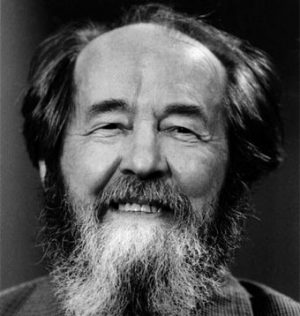
ALEKSANDR SOLZHENITSYN, writer month
 On the occasion of the centenary of his birth, Aleksandr Issaievitx Solzhenitsyn(Kislovodsk 1918 – Moscow 2008), is the writer of the month for December at the Municipal Library of Eivissa. Nobel winner, en Su main work “Gulag Archipelago” (1973) makes an extremely documented analysis of the Soviet prison system, terrorism and secret police.
Solzhenitsyn es hson of a Cossack landowner who died shortly before he was born and of a teacher, He spent his childhood in the city of Rostov-on-Don and studied physics and mathematics at the university of this city.. He was an artillery captain during World War II. He was sentenced to eight years of hard labor and perpetual exile for his opinions contrary to Stalinism..
He is sent to various work camps and thanks to his mathematical knowledge he was sent to a scientific research center for political prisoners., monitored by State Security. Despite Stalin's death in 1953, the exile continued in perpetuity, so he was sent to southern Kazakhstan from that year until 1956, which he took advantage of to write secretly while teaching at primary school. Released and rehabilitated in 1957, he was allowed to live in Vladimir and Riazan, located in the center of Russia, where I could live a normal life, teaching math and writing about his experiences in prison. His first works already placed him among the best writers of his time.: “A day in the life of Ivan Denissovitx” (1962), “Matryona's house” (1963), “Everything is for the cause” (1963) y “Miniatures in prose” (1964).
The last years of the decade of 1960 He spent them in a constant struggle to save his archives and manuscripts from the KGB., many of these spread throughout the USSR in rudimentary clandestine copies. His thinking progressively radicalized to extremes of anti-Soviet madness and medieval religiosity., attitude that decisively influenced the literary quality of later works, lower than the first. In this period he wrote “The first circle” (1968) y “cancer ward” (1969).
He was awarded the nobel prize for literature en 1970 but he refused to travel to Stockholm to receive the award for fear that the Soviet authorities would not allow him to return and to complete his main work. “Gulag Archipelago” (1973) where he makes an extremely documented analysis of the Soviet prison system, terrorism and secret police. The work unleashed a storm of attacks on the author in the press and in the Soviet media.. He was arrested and charged with treason. 12 February 1974 and the next day he was expelled from the USSR. He was deported to East Germany and deprived of Soviet citizenship.. He later settled in the United States. After the fall of the Soviet bloc he officially regained his Soviet citizenship and was able to return to his country in 1994, where he had a welcome worthy of a hero, Despite which he did not stop exercising critical thinking about Russia. Solzhenitsyn received criticism for opinions that his critics called reactionary and anti-Semitic..
ILLES.CAT
Literary Platform online