

NATALIA GINZBURG WRITER OF THE MONTH
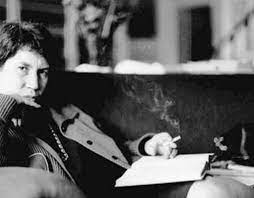
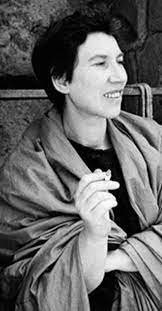 On the occasion of 150 anniversary of his birth and the 30th of his death, Natalia Ginzburg is the 5th writer of the month for October at the Can Ventosa Municipal Library. The Italian writer Natalia Levi (Palermo, 1916 – Roma, 1991) is one of the most unique voices in 20th century Italian literature.
Ginzburg was born into a left-wing secular family - her father was a free-thinking university professor from a Jewish family.- and spent the years of childhood and youth in Turin, where he didn't go to school, but he was educated at home. en 1934 He published his first story and became involved with the circle of anti-fascist intellectuals. (Pavese, Calvin…). In Turin, she met her future husband, editor and political activist Leone Ginzburg, founder of the Einaudi publishing house and head of the clandestine organization Justice and Freedom.
The political commitment of the couple resulted in their confinement, BETWEEN 1940 y 1943, in Pizzoli (Abruzzo). She was left a widow with three children. 1944, when Leone was captured by the Gestapo and tortured to death in a Roman prison.
Throughout his life he was a person committed to the clandestine resistance against fascism.. She had two more children from a second marriage with the university professor Gabriele Baldini.. During on estancia in Pizzoli, wrote his first short novel, Road to the city (1942), under the pseudonym Alexandra Tornimparte for anti-Semitic repression. But it was after the war that he dedicated himself fully to writing.. en 1952 Public Our yesterdays, Valentino (1957), the words of the night (1961), the essay The small virtues (1962) or the novel Family lexicon (1963), with which he won the Strega award. Then he published Dear Michael (1973) y family (1977).
I translated Proust, Maupassant and Flaubert. en 1965 wrote his first dramatic text, I got married for joy, which was a great success. He wrote up to eleven pieces with a strong narrative presence. In addition to novels, brief reports, theater and rehearsal he dedicated himself to his other passion, the cinema, to which some of his works were adapted.
Ginzburg interpreted Maria de Betània in the Gospel according to Saint Matthew by Pasolini. The film reviews he wrote for La Stampa were famous. He was a Member of the North American Academy of Arts and Sciences..
In 1983 she was elected to the Italian Parliament as an independent candidate., at the same time that he published his latest novel The City and the House. en 1989 published the biography Anton Chekhov, life through letters. Ginzburg was one of the most important voices in Italian and European literature of the 20th century..
ILLES.CAT
Online literary platform